

This is not my typical reporting or trend analysis. It starts as a fly on the wall but drifts into something much more personal halfway through, a reckoning with my first year living in the Bay Area, how the migration I observe mirrors my own.
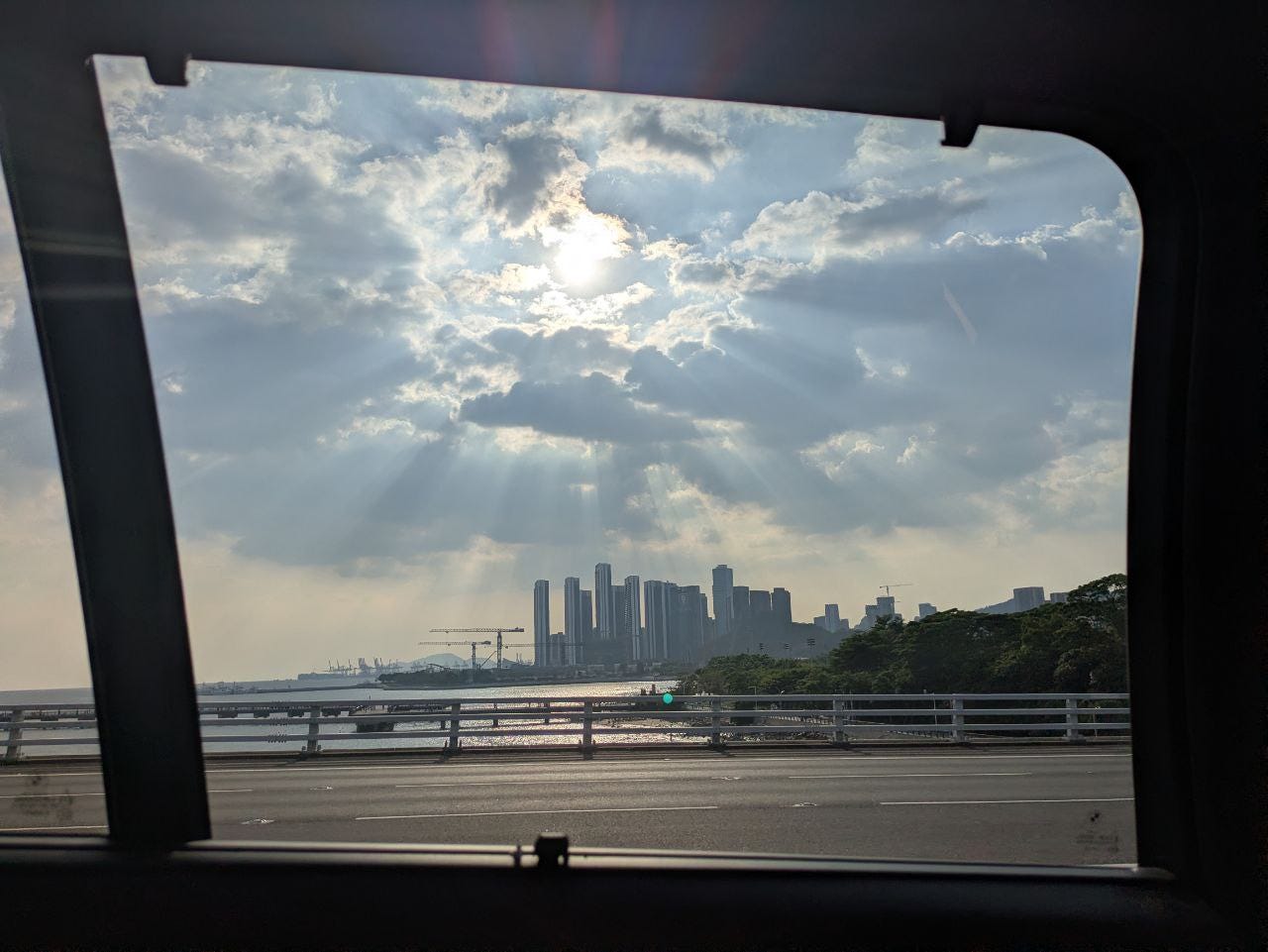
This is the first time in years I’m writing about China from afar. I used to dismiss remote reporting as inherently flawed, with second-hand information leading to broad-stroke generalizations about China’s consumer “edge” and frontier research “shortcomings” gleaned from a few parachuted trips. But now, from the Bay Area — the one framing San Francisco, not the Greater Bay Area around my hometown, Shenzhen — I’ve found justification for this distant observation.
What shapes China’s technological influence today isn’t happening in Beijing or SF alone but in the liminal space between, built by the globe-trotting entrepreneurs who belong fully to neither. My own migration mirrors theirs, constantly vacillating between the two worlds, never fully letting go of either.
Founders’s playbook
During my last year at TechCrunch, from 2023 to 2024, a question haunted me: Is this company Chinese? Mainstream media wields decisive power in classifying a startup’s identity — labels that carry heavy weight in Google searches, now large language models, and eventually people’s imagination.
Geographic labels — however convenient for journalists or politicians — carry baggage that obscures what matters. They flatten complexity, get weaponized in hostile debates, and overlook genuine innovation. But the vitality of Chinese startups lies precisely in their efforts to navigate geopolitical frictions while leveraging the talent and capital of both sides.
At the risk of oversimplification, here's a playbook I've observed from Chinese founders expanding to the US. These aren't just tactics — they reveal the founders' creativity, resourcefulness, and persistence.
Arbitrage labor: Hire an engineering team in China at a fraction of Silicon Valley rates. Iterate fast, win market share.
Study the competition: Make quarterly, if not more frequent, trips to catch wind of AI’s latest developments in the US.
Start with friendly capital: Seek seed funding from Chinese investors who are “safe” options — neither tied to the Chinese government nor on US authorities’ radar. USD-denominated funds with non-Chinese GPs are ideal for managing decoupling demands. Keep their ownership below 10% to preserve optionality for future US investors.
The strategy gives startups the early-stage capital for growth while keeping their cap tables open for larger Western checks later, all without forcing premature geographic allegiance. Some call this 小步快跑 (xiǎo bù kuài pǎo), running with short strides for rapid, incremental progress.
Prepare for the leap: When traction justifies a Series A, court US investors. The US commands the world’s largest VC market by a wide margin. While Chinese VCs are still active, they’ve been shrinking under geopolitical pressure and rarely have the coffers to bankroll later rounds.
To prepare for the fundraise, founders employ different FOMO-generating strategies based on their US know-how and access.
The savvy ones embrace “founder-led growth,” building up social media presence with hot takes and startup origin stories. Others, less familiar with the Silicon Valley culture, delegate virality-making to third-party agencies, dishing out tens of thousands to influencers to juice product launches.
But what attracts investors is real traction — user retention, actual contract value. Generate enough momentum, your US-based friends might volunteer to be your VC whisperers or become angels themselves.
Finish the migration: Getting funding from American VCs brings both validation and obligation. Startups must now demonstrate commitment, for perception and compliance.
Once Heygen raised from Sarah Guo’s Conviction, the AI video startup moved its team out of China. Manus relocated its management to Singapore, seen as a neutral ground between the two superpowers, and started hiring there aggressively following Benchmark’s investment.
Investors’ calculus
China’s consumer tech companies have a record of mastering products and distribution: DJI, TikTok, and now Manus. A flourishing service industry at home supports the initial stage of their global launches — influencer outreach, Meta ad buying, SEO optimization, you name it. And insight is often freely available online if one looks closely. Manus’s CEO credits his team’s ability to build global products to what anyone can access: developers sharing tips on Twitter/X, vloggers dissecting trends on YouTube.
But B2B? It’s a different game entirely. American investors won't likely bet on Chinese teams building SaaS — and for good reason. You need boots on the ground, years of industry intel, relationships that can’t be built through AI-written cold messages. You’d better be playing golf with prospective clients — a Zoom call from Shanghai won’t close deals.
Some American investors like Old Friendship Capital, founded by two Robinhood veterans, are actively pursuing what they see as the talent arbitrage: world-class teams developing consumer products from China with speed and cost efficiency. They wrote a check to Manus’s team toiling away in Wuhan even before the AI agent launched.
Geopolitical risk, in turn, often comes with valuation discounts. When Manus raised a $75 million round led by Benchmark, it was valued at $500 million — modest by Silicon Valley standards, as noted by Kevin Xu. Just eight months later, Meta acquired Manus for a reported price north of $2 billion, a staggering and rapid return to its early believers.
As it turns out, perception and traction tend to outweigh concerns around a startup’s origin, at least in the early stage. Residence status is a problem to solve later rather than an immediate dealbreaker.
I’ve seen Chinese founders on student visas raise millions from Silicon Valley investors, not despite their nationality but because they have undeniable traction for a local product. Just as important, they learn to speak the language that resonates with American VCs — something many foreign founders, not only Chinese ones, struggle with. My German and British friends ran into the same barrier. Fundraising in the US have forced them to be “louder and more unapologetically confident” than what would be acceptable back home.
When I consult for founders landing in the US, what I do resembles window dressing. I rewrite their LinkedIn profiles in the vernacular that signals “one of us” to Silicon Valley. I push them to attend local events, add contacts deliberately, take selfies with new connections, be opinionated on peers' posts, practice public speaking — all the things that build towards the perception of belonging.
Perception can’t be bought by parachuting into the Bay Area or dropping $100,000 on an influencer campaign. The seemingly viral Twitter/X posts, amplified by the same influencers and their armies of bots disguised as AI gurus, achieve little beyond exploiting information asymmetry. Chinese CEOs thrill at six-figure impression counts, only to find a week later that engagement is a ghost town and few investors have heard of their products.
The splintered world
Watching these founders navigate two worlds while I was doing the same, I realized that we are all living in transition, constantly code-switching, never fully at home.

When I arrived in the Bay Area last January, I couldn't pick where to stay, so my indecision became my residence — the Peninsula, halfway between SF and the South Bay. Keep driving south and you are in the expansive, manicured safety of Sunnyvale and Mountain View. This is where many of my Big Tech friends reside, seeking stability either as a lifestyle choice or as temporary compromise before securing green cards. Meanwhile, most of my entrepreneurial friends huddle in the city for access to investors, networking, and parties.
My Chinese friends who left Big Tech to start companies are typically US-educated like me. Their Chineseness is no longer a point of tension, but they still hold onto their China leverage — outsourcing engineering, prototyping hardware back home — while building products and fundraising in the same way any American founder would.
Their cultural fluency in both worlds becomes their greatest asset. As Kaiser Kuo observed, diasporic Chinese communities aren't instruments of any single state but participants in a shared global project.
Beyond the proliferation of authentic Chinese restaurants, 996 has quietly become normalized, as the likes of Elon Musk and YC-backed founders embrace the demanding work rhythms common in Beijing and Shanghai. I saw it firsthand one Wednesday night at a hacker house in San Francisco — a group of twenty-something founders playing board games. When I asked how they had time, one said: “We work the rest of the time!”
That nocturnal liveliness reminded me of Shenzhen’s tech districts, still brightly lit late into the night. In the picturesque, orderly Bay Area city I chose, the hustle and bustle of my hometown felt worlds away. Life here quickly began to feel quiet and homogenous. I found myself craving the kind of urban energy the Peninsula lacked.
I'd been pondering a move north — to SF — to chase the constant motion and surprise that had conditioned me in China. That’s why I found myself having midnight huevos rancheros in Mission on a chilly November night. The Salvadoran restaurant was loud and bustling. SF felt back.
That ease and excitement didn’t last long. Someone yelled, “Get down! Get down!” A small crowd surged through the door I was sitting by. My body hit the cold tiled floor before my mind could catch up. The air froze and the restaurant turned dead silent. My mind went to my parents half a world away. I should have stayed home. I might be dead. I'm sorry you have to carry this.
Two minutes passed, perhaps, but it felt like eternity. Then piercing sirens grew closer, blue and red light spilling across the windows above my head. Someone shouted: “We’re okay. We’re okay.” People stood up. From the chatter around me, I gathered that two men had been shot just beyond the window, a few feet from where I'd been eating. I was still trying to process the incident, but the world had already reset. People in their early twenties filed back in, talking about the shooting as if it were just another piece of news on Twitter/X.
An hour earlier, walking down a lively street, I'd declared to my friend, “SF is back! I need to move to the city!”
Boomeranging
In Shenzhen or any major Chinese city, you can brave the constant, minor agitations of life — the cutting in line, the scooter bump, the blaring phone-on-speaker on the subway — without calculating lethal consequences. You can commute anywhere, at any hour, knowing that security cameras capture every frame of your journey and guns are virtually impossible for an ordinary person to acquire.
In the US, freedom is measured in distance. You can get in a car at any moment, cross state lines, and drive to national parks without showing ID even once. But driving also narrows your contact with the world outside. Your only connection to the outside world is whatever you’ve chosen in advance: highway billboards, endless AI ads in the Bay Area, or a podcast queued up before the trip. There’s no room for daydreaming or people-watching, nothing like a crowded train where your body is carried along and your mind wanders freely.
It’s easy to romanticize a place you’ve left behind. Just two years after China reopened, the visceral agony of pandemic controls already felt like ancient history to me. During the pandemic, draconian, unpredictable policies prompted many to flee China, a phenomenon called 润 (rùn) — a word meaning “moist” but conveniently spelled R-U-N. Many of my friends ran. Others who stayed but criticized the regime then have largely moved on. When we catch up, they rave about new cafes in their cities, how cheap and convenient life in China is, and ask if the US is really as dangerous as the media portrays.


Some of my friends who ran have turned restless again. They struggle with the UK’s residency policy, long for New York’s energy from Berlin, and seek pathways from sleepy Vancouver to Silicon Valley’s AI boom. The US attracts them like a magnet even amid immigration chaos.
I wonder if they ever regret leaving China. A friend once said that the US and China are remarkably similar in their extremes of opportunity and risk, while the rest of the world is just... mellow. You could be celebrating SF's return to vibrancy, and the next moment running from a shooting. In Shanghai, you could be sipping coffee under the beautiful canopy of plane trees, only to go home and find your apartment chained up under pandemic lockdown.
People like my friends and me are a self-selected, restless group — always migrating, always scanning for greener grass. We chase progress yet crave comfort. We fight for causes yet are startled by how quickly we move on. Some of us are always in transit, with nowhere to belong permanently.
Roots
Every kid who grew up in Shenzhen has been to Window of the World, a theme park of miniature global landmarks that opened in 1993 and became a symbol of the city's role as China’s bridge to the world. Learning about the West and venturing out was the ethos of my generation who came of age during globalization's peak in the '90s through the 2000s. Even now, with trade wars running high, that impulse remains alive, though it’s no longer a consensus.
At a middle school reunion this past summer, the split was clear. About two-thirds of my classmates studied abroad; roughly half have returned. Many are now working in the public sector at their parents’ will, clinging to “golden rice bowls” as private sectors like finance and tech take regulatory hits.
Meanwhile, the people I meet through work in Shenzhen — almost exclusively migrants from other cities who never studied abroad — are far more enthusiastic about overseas opportunities. At first, it struck me as odd that none of my Western-educated classmates were working in outward-facing industries. But it makes sense. My work friends’ lack of 关系 (guānxi) — the intergenerational networks that exchange favors — pushes them to look for flatter terrain in the private sector. And that often means bringing products or software to entirely new markets.
In some sense, they feel more native to Shenzhen than my childhood friends who opt for stability. Shenzhen’s zeitgeist is one of ambition. Its charm lies in the drive and grit of people from every walk of life. I might be eating roast duck over rice for three dollars, eavesdropping on construction workers talking about their new year plans or engineers debating DeepSeek’s latest model at the next table. I once asked my masseuse, who grew up in a small rural village, why she stayed in Shenzhen despite fierce competition and seemingly unattainable property prices. She smiled: “Once you taste possibility, you can’t settle for less.”
I left China at sixteen and spent years struggling with a simple question: Where are you from? I didn’t have a good answer. But I’ve found my tribe now — the entrepreneurs who move between worlds, fluent in both. Working alongside them brings comfort: leaving China physically doesn’t mean letting go. I can exist in the space between.
Driving home from the Mission shooting, a coyote appeared in the middle of the crosswalk. My headlights caught its eyes, two amber gemstones, gleaming. It paused and stared, as if unsure whether it belonged to the urban backyards or the wilderness its ancestors knew. I understood.
Zhu he zhu he - congratulations! You absolutely nailed it!
This is so beautiful and moving, Rita! I always learn from your work and really appreciate your candid and heartfelt approach to writing about a sector I know so little about. Thank you for this!